The Race to Save India’s Oral Storytelling Before the Last Voices Fall Silent
A growing digitisation effort is trying to do what centuries of manuscript culture never had to: capture stories that were never meant to live on a page.
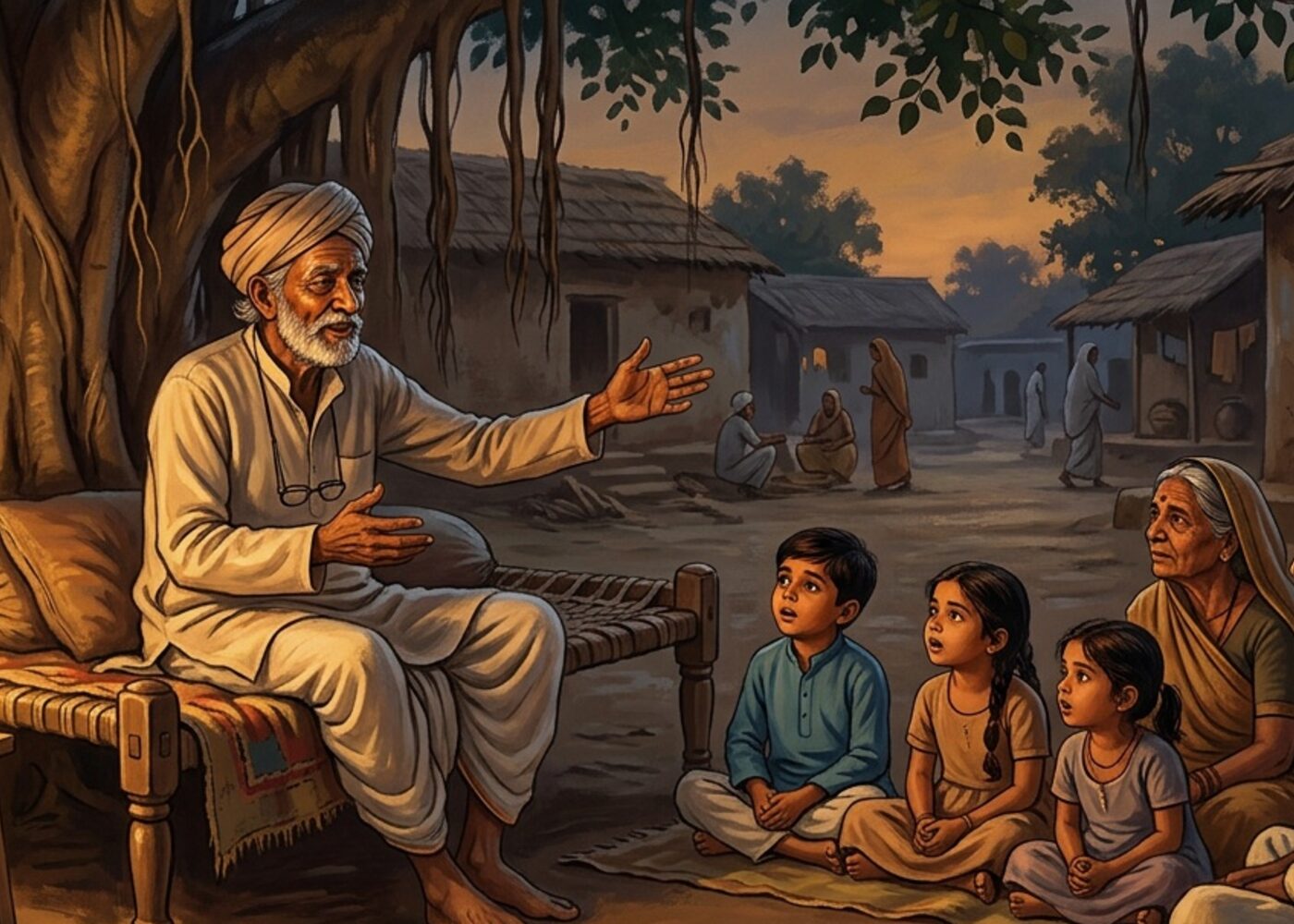
Image: Illustration commissioned by Antare Kala
Most of what the Sahitya Akademi and India's literary prizes celebrate arrives already printed. But a large share of the country's storytelling never made that journey — it lives in the cadence of a grandmother's lullaby, a bard's recitation at a village fair, a wedding couplet nobody wrote down because everybody already knew it.
The Ministry of Culture's Indian Culture Portal has spent the last several years trying to close that gap at scale, digitising more than 34 lakh bibliographic and archival records drawn from libraries, museums and archives across the country — a project that treats oral and folk material with the same cataloguing rigour as bound manuscripts. In parallel, the Oral History Association of India continues to train researchers in the specific discipline of recording testimony and folklore before it disappears with the people who carry it. Field researchers studying "Pothi Bacha" — the rural Odia tradition of reading and recounting sacred and epic texts aloud to a gathered audience — have documented how thin the surviving network of practitioners has become in several districts.
The urgency is structural, not sentimental: an oral tradition doesn't have a backup copy. When the person who holds a particular telling of a story stops telling it, that specific version — its pauses, its local references, its half-remembered verses — is simply gone. Digitisation projects can preserve a recording, but the harder, slower work is finding practitioners early enough to record them at all.
A manuscript can wait in an archive for a hundred years. A voice can't.
This is precisely the terrain Antare Kala's Sahitya pillar wants to spend time in — not just published authors, but the oral storytellers whose words never made it to a page, documented with the same care as any book.
Sources & Credits
- Indian Culture Portal, Ministry of Culture — National digitisation initiative for bibliographic and archival records
- Oral History Association of India — Training and field methodology for oral history documentation
- Field research on "Pothi Bacha" oral traditions — Rural Odisha storytelling practice
This is a desk report on public, verifiable developments — official announcements, award lists, festival programming and GI/UNESCO records. No individual is quoted here who has not made that statement publicly. Antare Kala's artist profiles, a separate and forthcoming content type, will carry direct interviews and consultation, per our editorial commitment: every artist we feature is credited, contacted, and consulted.